

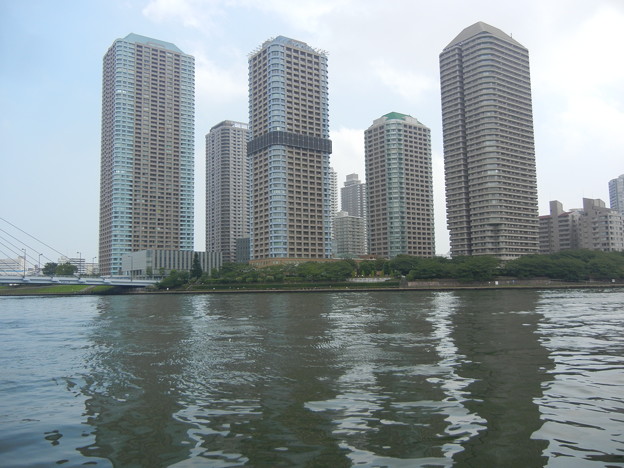
Something unusual is happening in the used condominium market.
The following is from a Nikkei article.
~ [Opening omitted]
The number of units in inventory was 10,827, up 33.6% from the same month of the previous year. The increase was particularly large in Tokyo's six central wards (Chiyoda, Chuo, Minato, Shinjuku, Shibuya, and Bunkyo), where prices have risen sharply. Inventory in October was 2,794 units, up 56.4% from the same month of the previous year. “Sellers' and buyers' desired prices are too far apart, making contracts difficult to conclude,” said Shinji Sakaki, president of Tokyu Livable, a major real-estate brokerage.
~ [Remainder omitted]
Meanwhile, prices of used condominiums have continued rising for 14 consecutive months.
Prices Keep Rising, but They Are Not Selling
If this situation continues, it will likely trigger a price decline.
They will not sell... one reason cited is the pile-driving issue involving Asahi Kasei Construction Materials. Reports now also describe a considerable number of cases of data reuse by major specialist pile-driving contractors, and some reports even said that data reuse was an industry practice. This will probably continue to have a psychological effect for a long time.
But many people think the opposite way. They hesitate to buy newly built condominiums, but used condominiums give them a sense of security.
“If it has not leaned even after 20 years, the piles must be sound,” and “If a condominium did not lean even during the Great East Japan Earthquake, the piles must be sound.”
One real-estate professional analyzes the reason used condominiums are attracting attention this way: “In the case of a defective condominium, some symptom tends to appear within roughly 10 years of construction. That is why some believe that choosing a property still in good condition after 10 years is a surer option,” the professional says.
In the end, the leaning-condominium issue may not be having that much of an effect on the used condominium market.
In fact, headwinds are beginning to blow against the condominium market in tax-related matters.
Tax-Saving Measures Using Tower Condominiums Will Become More Difficult
The National Tax Agency instructed tax bureaus throughout Japan to tighten their checks of inheritance-tax saving using tower condominiums (Nikkei, 2015/11/3 (Japanese)).
For tower condominiums, the land portion is small (because there are many units), while the building component accounts for a large part of the price (because construction costs are high).
The building portion is also depreciated, steadily diminishing in value. At inheritance, it is assessed at that diminished amount.
Upper floors often trade at high prices, so they also have an investment aspect. That is one reason they had been selling.
From now on, it has become difficult to put tax savings front and center.
The Financial Services Agency Requests a Review of Inheritance-Tax Valuation of Listed Shares as Part of Tax-Reform Requests
Incredibly, in its requests for next year's tax reform, the “Financial Services Agency” has requested a reduction in the inheritance-tax valuation of listed shares.
In fact, the fearsome National Tax Agency and the Financial Services Agency belong to the same household: the Ministry of Finance. In other words, if it came from the Financial Services Agency, the Ministry of Finance above it also says OK. It will happen.
At present, if you die leaving listed shares behind, a sad drama awaits.
Inheritance-tax valuation: 100%.
The shares have to be sold to pay the tax.
If the share price crashes between the date of death and the sale, paying the tax becomes even harder.
For that reason, as an inheritance measure, disposing of share certificates and converting them into land, buildings, or other assets was popular.
For example, if you convert it into land, the inheritance-tax valuation is roughly 80% of market value.
But the proposal from the Financial Services Agency this time would make 70% of the market value of listed shares the inheritance-tax valuation.
Isn't that more favorable than land!
Accordingly, from next year onward, purchases of real estate as assets to leave to descendants will probably decline.
(Postscript, 2015/11/30: reports that the LDP tax commission shelved it (Japanese), from the Nikkei)
It appears that even proposals from the Ministry of Finance, the strongest government agency, are being blocked by politics (the LDP). There were also reports that the proposal, likewise from the Financial Services Agency, to allow “the offsetting of gains and losses from transactions in shares and similar instruments against transactions in financial derivatives” that it had requested for the 2016 tax reform would also likely be shelved. The reason was that the problem of tax savings through derivatives could not be completely eliminated. In the first place, there is nothing in tax matters that can be “completely” eliminated, but...
In any event, tax-saving measures always carry the risk of tax reform.
Be careful, and review them every year.