

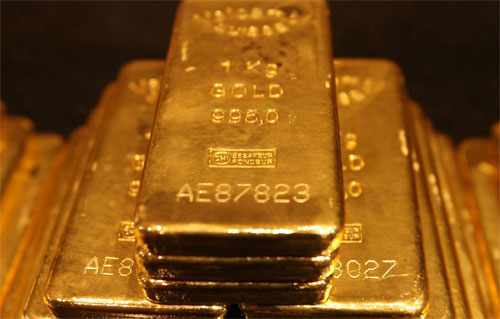
There was news of tax evasion involving gold bullion bars.
It has emerged that Union Bancaire Privée (UBP), a Swiss private bank used by the former convict known from the film “The Wolf of Wall Street” to hide funds, has agreed to pay $188 million (approximately ¥22.2 billion) to avoid prosecution by U.S. authorities for helping U.S. customers evade taxes.
According to a non-prosecution agreement announced by the U.S. Department of Justice on the 6th, UBP helped two U.S. customers remove gold bullion bars worth more than $50 million (approximately ¥5.9 billion at current exchange rates) and conceal assets from the U.S. Internal Revenue Service (IRS). At current values, the amount of gold taken out exceeds one metric ton.
Because gold has had universally recognized value since ancient times, is highly convertible to cash, and is difficult to trace, it has been used in many kinds of wrongdoing.
In this case, gold (the metal) and money (cash) were circulated through so-called paper companies—companies with no actual substance—known as ”sham entities” so that they could not be tracked. The bank also destroyed documents for tracing money in and out, so it was subjected to a substantial penalty.
Some readers may wonder why a Swiss bank is subject to a U.S. penalty. Under the powerful regulation known as the FCPA, the United States punishes improper payments, including those made abroad. Financial institutions such as banks that conduct international transactions always keep FCPA regulations in mind when making overseas remittances and the like. That said, because sovereignty is involved, it is limited to matters involving U.S. citizens or persons (including corporations) in the United States. This case, too, concerned U.S. customers.
They took out a whole metric ton to hide assets, even though all the gold in the world is said to be only enough to fill one swimming pool.
At today’s market price, 1 gram of gold is ¥4,506, so that means they took out ¥4.5 billion worth of gold per metric ton.
Characteristics of Precious Metals (Such as Gold) in Tax Matters
Used to Conceal Assets
Several decades ago, gold bullion bars were often hidden in the safes of wealthy people’s homes. Gold bullion bars are better than cash kept at home, aren’t they?
Gold was around ¥1,500 per gram in 1979 and is now close to ¥5,000. It was around ¥1,100 per gram in 2000, so the increase since then has been remarkable. Its convertibility (liquidity) may not be an issue, but market fluctuations create a risk of changes in value. Then again, the value of currency also changes with inflation rates and so on, so it is the same in that respect.
Given these characteristics of gold, I think you can easily see why it is readily used to convert and conceal wealth or to carry it around.
It was learned on the 3rd that 210 gold bullion bars (with a market value of approximately ¥563 million) and approximately ¥670 million in cash had been found beneath the floor of a storehouse at the home of a company president in his 60s in Nagano Prefecture, whom the Nagano District Public Prosecutors Office had arrested on suspicion of violating the Inheritance Tax Act for evading more than ¥700 million in taxes.
At today’s prices, each gold bullion bar is around ¥5 million, so this means that more than ¥1 billion in gold was hidden under the floor.
Normally, people hold gold in expectation of future price increases, but some hold it for various reasons, including as a way to evade inheritance or gift taxes, so that movements in their assets cannot be ascertained as they can with bank deposits.
On March 6, 1993 (Heisei 5), a former vice president of the Liberal Democratic Party was arrested on suspicion of tax evasion. It was truly a case of being hit from all sides. Tokyo prosecutors alleged that he had accumulated wealth by converting secret donations from general contractors into discount bonds, and ¥3 billion in discount bonds and gold bullion bars were seized from a safe at his Tokyo home. He strongly denied the tax-evasion allegations during questioning, but the Tokyo District Public Prosecutors Office indicted the former vice president.
The then vice president was arrested on suspicion of violating the Income Tax Act because he had concealed gold bullion bars he received without declaring them. It is like the familiar world of the corrupt magistrate and Echigoya in period dramas saying, “You are wicked too,” over manju cakes (koban coins).
Used for Smuggling and Tax Windfalls
Long ago, koban gold coins were currency. Japan, called Zipangu, the land of gold, was rich in gold, but large amounts were also exchanged for silver by taking advantage of differences in silver prices, and flowed overseas.
There was also an era when “gold and silver = currency.”
The gold standard has now ended, so officially gold is no longer in a position equivalent to money. At the individual level, however, many people may still feel that gold is to some extent almost money itself.
Consumption tax does not apply to money. It is the same as not applying when money is lent or borrowed. It is imposed strictly on “consumption.” Land is not consumed either (it does not diminish with use), so consumption tax does not apply to it.
However, for reasons I do not know (policy reasons?), consumption tax somehow applies to gold. There are many countries where gold is subject to consumption tax, but there are also countries where it is not. For example, Hong Kong has no consumption tax. In the United States, sales tax on gold is exempt up to a certain amount, so it can be bought tax-free. Gold prices are also not identical worldwide; they can differ slightly by country.
For this reason, people may buy it cheaply and resell it in a country where it is more expensive, import and export it to move assets overseas, or make the amount of the consumption tax as profit (a tax windfall) by buying it in a country without consumption tax and selling it in a country where it applies.
On the 7th, the Osaka District Public Prosecutors Office Special Investigation Unit arrested a man in his 60s who ran a cosmetics sales business in Osaka Prefecture and his son, an employee in his 30s, on suspicion of violating the Customs Act (attempted unlicensed import), for allegedly attempting to smuggle 64 gold bullion bars (worth approximately ¥300 million) through Kansai International Airport. The unit believes they intended to sell the smuggled gold in Japan and improperly obtain approximately ¥15 million, the amount of consumption tax.
The allegations state that on May 26 this year, when returning to Kansai Airport from South Korea, they attempted to smuggle the 64 gold bullion bars (approximately 1 kilogram each) by concealing them in a handbag and passing them off as cosmetics.
(2013/11/7 Mainichi Shimbun (Japanese))
They were carrying 64 kilograms in a handbag... Strong people.
From a tax perspective, if gold is imported as a business and does not fall under “small-value imported goods,” for which the exemption threshold is a tax amount of ¥10,000 or less, consumption tax must be paid when it is brought into Japan.
If it is not being done as a “business” and is brought in personally rather than as a business, consumption tax does not apply in principle.
However, customs authorities seem to treat a person who brings back gold bullion bars exceeding 1 kilogram as being engaged in a ”business” as a basic rule, and seem inclined to impose consumption tax. The Customs website says, “For details, please ask an official,” so if it is recognized there that the purpose is not a “business,” such as resale, consumption tax may not apply (Reference: Customs website No. 7305 (Japanese)).
On the 9th, the Shimonoseki Customs Branch of Moji Customs (Shimonoseki, Yamaguchi Prefecture) referred a truck driver in his 50s from Takamatsu City to the Shimonoseki Branch of the Yamaguchi District Public Prosecutors Office on suspicion of violating the Customs Act (attempted unlicensed import) and the Consumption Tax Act, among other allegations, for allegedly trying to smuggle approximately 20 kilograms of gold bullion bars by ferry from South Korea and evade consumption tax payable when importing foreign goods. In smuggling cases involving gold, the use of a ship is said to be unusual.
Omitted ~ When returning to Japan after unloading live fish, he is suspected of attempting to smuggle approximately 20 gold bullion bars weighing about 1 kilogram each by hiding them between the driver’s cab and the live-fish tank.
It appears that he smuggled it to make a little spending money on the way back. It is unclear whether he did it himself or was a courier.
2016/1/14 Addendum
In a case in which a total of 10 men and women were arrested on suspicion of violating the Customs Act (attempted unlicensed import), violating the Consumption Tax Act (attempted tax evasion), and other offenses for, among other things, smuggling gold bars and luxury watches worth a total of ¥1 billion from Hong Kong into Kansai International Airport while disguising them as cosmetics, the Kansai Airport Customs Branch of Osaka Customs displayed the seized items to the press on the 14th.
The gold bars comprised 130 one-kilogram bullion bars, for a total of 130 kilograms (worth approximately ¥603 million), the largest quantity since the airport opened in 1994 (Heisei 6), in terms of gold seized at Kansai International Airport.
Omitted
With the increase in consumption tax to 10% next April virtually certain, customs officials are becoming more vigilant, saying, “There is concern that smuggling will become even more active. Stopping it at the border is indispensable.”
Worth ¥1 billion...

The methods used to smuggle gold seem to include the following:
- Concealing it in a vest with many pockets
- Putting it in the battery slot of a laptop computer
- Using a silicone pad to imitate a pregnant woman’s abdomen
- Stuffing it inside the body
- Hiding it in underwear
- Making gold hangers and bringing them in with clothing
- Disguising it as food such as sugar
- Hiding it by making a double bottom in cans and similar containers
- Hiding it beneath the lining of a suitcase
- Placing it in the handle of a carry bag
Gold has retained value throughout recorded human history, so I feel that this sort of thing will not disappear as long as faith in gold does not disappear.
By the way, gold in Hong Kong used to be cheap by global standards, so I think many people bought gold as a small souvenir on their return from trips to Hong Kong. At present, however, gold in Japan is at a low price level.
Profits from Selling Gold Are Subject to Income Tax
When gold is converted into yen and a profit is made compared with its purchase price, it must be reported for income tax purposes. This is the same as an ordinary sale of goods, so it will probably not seem strange.
(An Extra) There Was Actually Gold That Was Not Subject to Inheritance Tax
Normally, gold is property, so it is taxed on inheritance. However, perhaps out of consideration for cultural matters, Buddhist altars and the like are outside the scope of inheritance tax and can be passed on tax-free. There is demand among some people for expensive Buddhist altars that use a great deal of gold. There are even pure-gold “orin” bells that make a chime and cost ¥10 million. You could not casually invite people into your home. Since processing charges are also added on considerably, in many cases more money may remain if you simply pay the inheritance tax.
So, what did you think? I hope you could get a sense of the various things that happen in the world by taking advantage of small differences in taxes.
This article is written for reading enjoyment. Please be very careful not to misuse it.