


The National Tax Agency refers to major holders of securities, real estate, and the like, and people whose recurring income is especially high, as "so-called wealthy individuals."
At the time this was published, a search for "wealthy individuals" on the National Tax Agency website returned 137 results. The most recent document at that point was the Sapporo Regional Taxation Bureau's results of its responses to wealthy individuals.

For the 2014 administrative year in Sapporo, the additional tax assessed came to JPY 325 million. It was announced with considerable pride (National Tax Agency website (Japanese) press release).
Why Wealthy Individuals Are Targeted
As you know, Japan adopts a progressive income-tax system, under which the tax rate rises as income increases.
For this reason, concentrating investigations on people with high incomes is more likely to produce greater results (such as additional assessments), and wealthy individuals are one of the targets for focused investigation.
The National Tax Agency's definition of "wealthy individuals" has not been made public. Presumably, it responds by flexibly changing its internal standards to suit the times.
The Ever-Tightening Tax Net Around Wealthy Individuals
Let us look here at regulations and procedures newly established by the National Tax Agency in recent years.
| No | Name | Effective period | Conditions | Details |
|---|---|---|---|---|
| 1. | Statement of Overseas Assets | From 2014 | Residents other than non-permanent residents with overseas assets exceeding JPY 50 million at year-end | Submit to the competent tax office for the taxpayer's place of residence, etc., by June 30 of the following year |
| 2. | Exit Tax (Taxation upon Overseas Departure) | From July 2015 | Covered assets of JPY 100 million or more, and a period of more than five years during which the person had an address, etc., in Japan within the preceding ten years in principle | At the time of overseas departure, tax unrealized gains by deeming the covered assets to have been transferred, etc. (a deferral of tax payment is available with certain procedures and provision of security) |
| 3. | Statement of Assets and Liabilities | From the 2015 tax year (revised from the 2023 tax year) | Income exceeding JPY 20 million and assets of JPY 300 million or more, etc., or assets of JPY 1 billion or more | Submit to the competent tax office for the place of tax payment for income tax, etc., by June 30 of the following year |
| 4. | Bank Account Numbering System | From 2018 (expanded in April 2025) | Notification of the My Number is voluntary | Numbered bank accounts may be used to confirm their location at the time of inheritance or disaster, etc. |
| 5. | Automatic Exchange of Financial Account Information for Non-Residents (CRS) | From 2018 | Financial accounts of non-residents identified by reporting financial institutions | Tax authorities in each country automatically exchange information under tax treaties, etc. |
The 2015 article stated the following.
They are increasing almost every year. The ultimate measure will be the introduction of the My Number system. This will create the foundation for every system going forward.
By the way, in India, a My Number-advanced country that began introducing My Numbers in 2010, it is easy to apply for a new allocation of a taxpayer identification number (PAN), so people can have multiple numbers. Japan appears set to operate its system on a one-person, one-number basis.
The 2015 article forecast the following development.
The Commissioner of the National Tax Agency announces management guidelines for key managed wealthy individuals. The future direction becomes clear.
At the nationwide meeting of Regional Taxation Bureau directors of taxation departments (First and Second), the existence of a document titled "Trial Concerning Management, etc., of Key Managed Wealthy Individuals (Instruction)" was revealed. The Commissioner of the National Tax Agency first introduced it at the Tokyo, Osaka, and Nagoya Regional Taxation Bureaus and planned to roll it out nationwide thereafter. This document was then called the "trial" circular; it was not an ordinary formal circular but one still at the "trial" stage.
This is a good text for understanding the National Tax Agency's thinking, so I will explain it.
Reviewing the Cover (Trial Concerning Management, etc., of Key Managed Wealthy Individuals
Trial Concerning Management, etc., of Key Managed Wealthy Individuals (Instruction)
June 29, 2015
With respect to the matter in the title, the attached "Operational Guidelines for the Management and Investigation Framework for Key Managed Wealthy Individuals" have been established. From July 10, 2015, please implement them appropriately in accordance with these Guidelines in place of the joint directive of five divisions dated June 21, 2005, Kaso 5-4 et al., "Concerning the Management and Investigation Framework for Holders of Overseas Financial Assets, etc." (Operational Guidelines).
(Purpose)
For so-called wealthy individuals, it has become important to accumulate information and materials collectively, including those of related individuals and corporations, and to analyze information from multiple perspectives from both profit-and-loss and balance-sheet perspectives, in order to accurately identify non-business income in light of the diversification and internationalization of asset management and to understand medium- to long-term trends in assets held, also taking into account the perspective of asset taxation.
Accordingly, these Operational Guidelines set out matters requiring attention in conducting a trial to enhance and strengthen the management and investigation framework for wealthy individuals who should be managed with particular focus (hereinafter, "key managed wealthy individuals").
I added the underlining and colors, so they are not in the original.
Let us look at each one.
Diversification and Internationalization of Asset Management
This goes without saying, but stock investment, financial derivatives, and foreign-exchange margin trading (FX) have also become quite common. It is also only recently that it has become possible to buy and sell shares in companies listed overseas while remaining in Japan (more precisely, quasi-securities called ADRs).
Accurate Identification of Non-Business Income
Wealthy individuals have substantial income from dividends and interest, and income from the transfer of assets, which does not come from business but from asset management and the like. This is also discussed in Piketty's economics.
There may be differences in scale, but it is likely true that there is income that escapes being captured. Identifying such income is also listed as one of the objectives.
Also Taking into Account the Perspective of Asset Taxation
The 2015 article stated the following.
Something alarming has appeared. Asset taxation is being contemplated.
Asset taxation means taxing property. Taxes are imposed according to the amount held as property, such as deposits, land, securities, and claims. Inheritance tax and fixed-asset tax are asset taxes.
What will be taxed in the future? Will that depend on policy and revenue shortages?
It seems that the implementation of asset taxation is a foregone conclusion.
Both Profit-and-Loss and Balance-Sheet Perspectives
The phrase "both profit-and-loss and balance-sheet perspectives" also indicates a policy of understanding not only the flow of income but also asset and liability balances together. Balance-sheet refers to asset and liability balances.
The 2015 article interpreted it as follows.
Until now, taxation has focused on the flow of money (flow), such as profit and loss (salary income), but many people have substantial assets even if their income (flow) is small. Indeed, people with substantial assets often use tax-saving measures such as company expenses, so their income may consequently be low. Focusing on income could leave assets subject to inheritance tax and other asset taxes uncaptured. Going forward, the policy appears to be to understand matters from both sides.
Let Us Look at the Next Main Text
Reviewing the Operational Guidelines for the Management and Investigation Framework for Key Managed Wealthy Individuals
Attachment
Operational Guidelines for the Management and Investigation Framework for Key Managed Wealthy Individuals
Article 1 Purpose of Management
For key managed wealthy individuals and their controlled corporations, etc., in addition to domestic transactions, tax matters relating to overseas transactions also need to be considered. Beyond income taxation of these persons, medium- to long-term management that also takes asset taxation into account, including inheritance planning, must be conducted across bureaus, tax offices, and administrative functions, and a framework must be established to consolidate various information and materials and accurately plan and carry out comprehensive investigations.
Therefore, the trial divisions shall prepare lists of key managed wealthy individuals and their controlled corporations, etc., and manage them collectively, share those lists with related divisions, and, by smoothly consolidating various information and materials and conducting multifaceted analysis, carry out continuous and focused management and accurate investigations of those persons.
Article 2 Management Framework
1. Designation of Persons Subject to Management
The trial division shall, in consultation with the bureau's General Taxation Coordination Division and responsible division, designate key managed wealthy individuals by the end of May each year.
At that time, where the controlled corporations, etc., of a key managed wealthy individual form a large group spanning bureaus, attention shall be paid to conducting the necessary coordination, etc., through close communication with the trial division or General Taxation Coordination Division of the related bureaus.
2. Criteria for Designating Persons Subject to Management
Persons designated as key managed wealthy individuals (hereinafter, "persons subject to management") shall be persons who meet any of the following criteria.
(1)Formal Criteria
Persons whose estimated total assets held are especially substantial.
(2)Substantive Criteria
Among persons who do not meet the formal criteria, persons who hold assets of a certain scale or greater and for whom international tax avoidance or other issues inherent to wealthy individuals are anticipated, and who are found to require special designation as key managed wealthy individuals.
3. Scope of the Group of Persons Subject to Management
The persons subject to management and the following persons among their related persons (hereinafter, the "group of persons subject to management") shall be listed in the "Key Managed Wealthy Individuals List" (appendix) and managed collectively.
For related corporations, tools such as the "Corporate Group Management Register" or "Consolidated Parent-Subsidiary Corporation Detail Sheet" shall be used.
(1) Related Individuals
Related individuals means persons found to have a particularly close relationship with a person subject to management.
(2)Core Corporations
Core corporations means, among the corporations controlled by a person subject to management, corporations that form the central entity of the group of persons subject to management.
(3)Related Corporations
Related corporations means corporations other than core corporations that are found to have a particularly close relationship with a person subject to management or a related individual.
4. Taxpayer Management
(1) Management Using the Key Managed Wealthy Individuals List
The trial division shall conduct continuous and focused management of groups of persons subject to management based on the Key Managed Wealthy Individuals List and consolidate various information and materials.
At that time, where a person subject to management is a person subject to management of an important case as provided for in the joint directive of five divisions dated June 27, 2014, Kaso 6-4 et al., "Concerning the Establishment of Important Case Management Guidelines" (Operational Guidelines), the consolidated information and materials shall be provided to the Supervising National Tax Field Examiner (in charge of important cases), with care taken to avoid duplication of taxpayer-management work.
Where a person subject to management has no actual residence at the address treated as the person's place of tax payment and has the principal place of living within the jurisdiction of another Regional Taxation Bureau, the necessary consultations shall be held with the trial division or General Taxation Coordination Division of the related bureau.
(2) Submission of the Key Managed Wealthy Individuals List to the Agency and Feedback to Other Bureaus
The trial division shall submit the prepared Key Managed Wealthy Individuals List to the Agency's General Taxation Coordination Division via the bureau's General Taxation Coordination Division by the end of May each year, and the Agency's General Taxation Coordination Division shall, based on the submitted lists, send the lists of the applicable groups of persons subject to management to the trial divisions via the General Taxation Coordination Divisions of the bureaus having jurisdiction over the places of tax payment of the core corporations, related corporations, or related individuals of the persons subject to management (hereinafter, "related corporations, etc.").
(3) Sharing of the Key Managed Wealthy Individuals List Among Related Divisions
The Key Managed Wealthy Individuals List shall be shared by the related departments and divisions within the bureau and by the competent tax offices. In doing so, all lists managed by the trial division shall be provided to the related departments and divisions within the bureau, and only the lists concerning groups of persons subject to management to which taxpayers under the jurisdiction of the relevant tax office belong shall be provided to the chief supervising officer at the competent tax office, with the category-management and important-case-management fields left blank (including lists of groups of persons subject to management managed by other bureaus that were sent from the Agency).
The chief supervising officer shall distribute the received lists to the supervising officers, etc., responsible for the applicable taxpayers.
(4) Category Management
The trial division shall, based on multifaceted analysis of various information and materials concerning groups of persons subject to management and on past examples of disallowances and cases difficult to tax concerning wealthy individuals, determine by the end of May each year, for each person subject to management, which of the following three categories applies, and respond as follows based on that management category: 1. persons for whom tax issues are anticipated and for whom commencement of investigation planning is found appropriate (Category A); 2. persons for whom tax issues have not become apparent but for whom continued attention is found necessary, for example because significant movements in assets held are observed (Category B); or 3. persons who fall under neither 1 nor 2 and for whom ongoing observation is found appropriate (Category C).
I Response to Category A
For persons subject to management categorized as Category A, the trial division shall consolidate and analyze the information and materials necessary to identify tax issues, etc., concerning the relevant group of persons subject to management, and the bureau's General Taxation Coordination Division shall, after consultation with the trial division, instruct the investigation-planning division to plan an investigation.
For persons subject to management categorized as Category A, in principle, no investigation shall be conducted by the bureau or tax office, including of the related corporations, etc., of the person subject to management (excluding corporations under the jurisdiction of the bureau's investigation division), until investigation planning has been completed. In doing so, the trial division shall designate cases in which no investigation is to be conducted and notify the chief supervising officer at the competent tax office via the bureau's General Taxation Coordination Division and the responsible division.
Where, after being notified that a case is one in which no investigation is to be conducted, the chief investigation officer at the competent tax office needs contact by the investigation division to confirm the cause of a consumption-tax refund, etc., the officer shall promptly notify the bureau's General Taxation Coordination Division through the responsible division. Upon receiving the notification, the bureau's General Taxation Coordination Division shall, after consultation with the trial division, determine whether contact is necessary and notify the chief supervising officer at the competent tax office through the responsible division.
Where a core corporation or related corporation is a corporation under the jurisdiction of the bureau's investigation division, the trial division shall consult with the Investigation Management Division, etc., concerning plans for field investigations of the corporation and the collection, etc., of information and materials useful for managing the relevant group of persons subject to management.
Ro Response to Category B
For persons subject to management categorized as Category B, the trial division shall proactively endeavor to collect and accumulate useful information and materials in order to analyze from multiple perspectives trends in assets held and whether suspicious transactions exist, etc., in the relevant group of persons subject to management.
For the relevant persons subject to management, investigations may in principle be conducted by the bureau or tax office, including of related corporations, etc.; however, when conducting an investigation, the trial division shall, via the bureau's General Taxation Coordination Division and the responsible division, specifically instruct or request the investigation division or related division to collect information and materials useful for multifaceted examination and analysis of the relevant group of persons subject to management. After the investigation ends, the investigation division shall submit the relevant information and materials to the trial division via the responsible division and the bureau's General Taxation Coordination Division.
Even for related corporations, etc., for which an investigation is not planned, where it is found necessary to ascertain useful information and materials concerning the relevant group of persons subject to management, the bureau's General Taxation Coordination Division may, after consultation with the trial division and related divisions, instruct or request an investigation of the relevant related corporations, etc., at an appropriate time. After the investigation ends, the investigation division shall submit the investigation results and collected information and materials, etc., to the trial division via the responsible division and the bureau's General Taxation Coordination Division.
Ha Response to Category C
For persons subject to management categorized as Category C, investigations may in principle be conducted by the bureau or tax office, including of related corporations, etc.; however, when conducting an investigation, the bureau's General Taxation Coordination Division shall, after consultation with the trial division, specifically instruct or request the investigation division or related division, through the responsible division, on the matters to be collected so that useful information concerning investment behavior, etc., of the relevant group of persons subject to management or wealthy individuals generally can be obtained.
After the investigation ends, the investigation division shall submit the investigation results and collected information and materials, etc., to the trial division via the responsible division and the bureau's General Taxation Coordination Division.
Ni Reclassification of Category Management
Where the trial division reclassifies the category of a person subject to management, it shall promptly report this to the Agency's General Taxation Coordination Division and notify the responsible division accordingly via the General Taxation Coordination Division of the bureau having jurisdiction over the person subject to management and related corporations, etc.
(5) Taxpayer Management with Varied Levels of Intensity
From the viewpoint of effectively using limited staff time, the trial division shall endeavor to allocate staff time appropriately in accordance with the management categories set out in (4).
In particular, it shall concentrate staff time on persons subject to management categorized as Category A and accumulate and analyze information and materials for investigation planning.
(6) Cancellation of Designation, etc.
Among persons subject to management (limited to persons designated under the substantive criteria), those categorized as Category C who, as a result of continuous management in that category, are found no longer to require particularly focused management shall have their designation as key managed wealthy individuals cancelled. The trial division shall promptly report this to the Agency's General Taxation Coordination Division via the bureau's General Taxation Coordination Division and notify the responsible division accordingly via the General Taxation Coordination Division of the bureau having jurisdiction over the person subject to management and related corporations, etc.
Further, among related corporations, etc., persons who, as a result of collective management with the person subject to management, are found no longer to require the continuation of such management shall be removed from the Key Managed Wealthy Individuals List.
Information and materials collected on persons whose designation as key managed wealthy individuals has been cancelled and on persons removed from the related corporations, etc., of key managed wealthy individuals shall be provided to the related divisions within the bureau.
(7) Notification to the Bureau When Conducting Field Investigations
A tax office having jurisdiction over a person subject to management or related corporations, etc., shall, when conducting a field investigation of a taxpayer managed as part of a group of persons subject to management, notify the bureau's General Taxation Coordination Division having jurisdiction over the place of tax payment of the person subject to management via the responsible division and the General Taxation Coordination Division of the bureau having jurisdiction over the person subject to management or related corporations, etc., no later than three weeks before the prior notice (or, in the case of no prior notice, no later than four weeks before the planned investigation start date; provided, however, that where the tax office conducting the field investigation is outside the bureau jurisdiction having responsibility for the person subject to management, promptly after the start of the investigation).
When notifying the bureau, a copy of the Key Managed Wealthy Individuals List shall be attached together with the Investigation Procedure Checklist (for prior notice) or the Assessment Form for Appropriateness of an Investigation Not Requiring Prior Notice.
The bureau's General Taxation Coordination Division receiving the notification shall consult with the trial division and, as described in (4) Ro or Ha above, specifically instruct the investigation division to collect information and materials useful for multifaceted examination and analysis of the relevant group of persons subject to management, through the responsible division having jurisdiction over the person subject to management or related corporations, etc. After the investigation ends, the investigation division shall submit the relevant information and materials to the trial division via the responsible division and the bureau's General Taxation Coordination Division.
5. Consolidation of Information and Materials, etc.
For all groups of persons subject to management, the trial division shall carefully select information and materials to be continuously consolidated and managed and, in principle, consolidate them in the trial division of the bureau having jurisdiction over the place of tax payment of the person subject to management via the responsible division having jurisdiction over the person subject to management and related corporations, etc., and the bureau's General Taxation Coordination Division.
For groups of persons subject to management categorized as Category A or Category B, other information and materials shall also be collected and managed as necessary, depending on the degree to which tax issues are to be identified or trends in assets held are to be understood, etc.
In consolidating this information and these materials, consideration shall also be given to the administrative burden on bureaus and tax offices.
Article 3 Investigation Framework
~ Omitted ~
Article 4 Requests, etc., to Investigation Management Divisions for Information Collection
~ Omitted ~
Image of the Key Managed Wealthy Individuals List
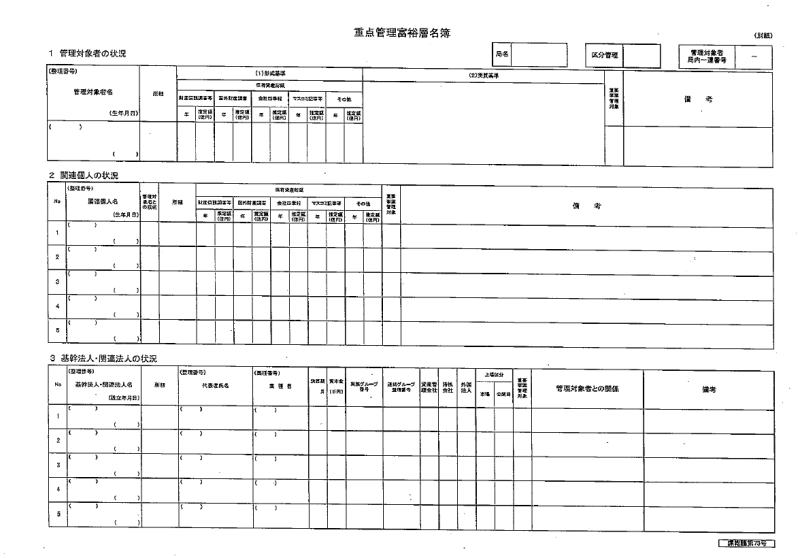
Summary of the Operational Guidelines for the Management and Investigation Framework for Key Managed Wealthy Individuals
- Classify wealthy individuals into Category A (potential tax concerns), Category B (information collection), and Category C (monitoring progress) to investigate efficiently
- For investigations, the trial division, rather than the usual staff in charge, takes the lead
- Also organize the related corporations and individual relationships of wealthy individuals as necessary
- For estimating wealthy individuals' assets, use Statements of Assets and Liabilities, Statements of Overseas Assets, the Japan Company Handbook, media articles, etc.
That is the gist, I suppose. So tax offices make use of the Company Handbook. From the situation of major shareholders, they can determine how much in assets a person has from the share price and number of shares held, and whether the shares have been moved through sales and purchases.
The 2015 article concluded as follows.
With the spread of My Number, it is expected that society will move toward stronger asset taxation and comprehensive taxation including investments, etc. Of course, this is an area in which there will be much public opposition, so elections will also have to be considered, and I do not think it will advance so easily. But considering the shortage of revenue sources, the sense of crisis that tax revenue must be increased may prevail, and society may change surprisingly quickly.
Personally, if the spread of My Number makes things clear, I would like to see tax administration greatly reduced and a smaller government pursued. Oh, but then the work of tax accountants would decrease too (laugh).