


Many companies in Japan have a March fiscal year-end.
When people establish a new company, they often choose the calendar month preceding the month of incorporation as their fiscal year-end month. There are several reasons for this, including reducing administrative work and, when the requirements are met, qualifying for an exemption from consumption tax.
The 2015 article said the following:
April also has the largest number of newly established corporations. Perhaps many people leave their jobs at the end of March to start their own businesses.
Personally, I had expected more people to quit and start businesses after receiving their bonuses around June, but I was wrong.
Joking aside, how should you choose your fiscal year-end month?
Choose Your Fiscal Year-End Month This Way! Textbook Considerations
- Year-end accounting and adviser fees
- Busy and slow seasons
- Tax savings, particularly for consumption tax
- Cash flow (the timing of tax payments)
That about covers it.
Year-end accounting and adviser fees arise when the year-end procedures are performed, so a short fiscal period still means incurring those fees.
If your industry has a busy season, it is also safer to avoid that period and choose a slow season instead. During the busy season, put all your energy into earning as much as you can.
A discussion of ways to save on consumption tax would get lengthy, so I will cover that another time.
As for cash flow, if your business is affected by seasonal factors, as apparel businesses are, it is a good idea to separate the timing of your tax payments from the timing of your inventory purchases.
The 2015 article said the following:
February is commonly seen as a popular fiscal year-end month in retail because of the industry's busy season, but I get the sense that this trend is becoming less pronounced.
Global companies, including subsidiaries of overseas companies, often use December. In particular, if the parent company is publicly listed, a fiscal year-end other than December may not be permitted. From headquarters' perspective, having a subsidiary whose fiscal year does not align with its own is a nuisance to manage.
Then there is the urban legend that your fiscal year-end affects the likelihood of a tax audit.
The idea goes that choosing March, when fiscal year-ends are concentrated, stretches the tax office's resources thin and makes you less likely to be audited... That has not been my experience, so perhaps it really is just an urban legend.
Choose Your Fiscal Year-End Month This Way! Omens and the Supernatural
Let us also consider the “Do you believe in God?” approach to making the decision.
A remarkably large number of successful entrepreneurs are concerned with good luck.
When they are just starting out, it may be the company seal they have made at incorporation. Some are particular about its material and typeface.
Once the business is up and running, it may be the location and design of the office.
Ask someone who built a company from the ground up, and they will enthusiastically tell you one or two supernatural stories, so it is worth asking. I have yet to hear of anyone being particular about their fiscal year-end month, though...
Below, we will process statistical data published by the National Tax Agency and see what tendencies companies with each fiscal year-end month exhibit.
Unless otherwise noted, the figures are based on data from April 1, 2010 through March 31, 2011, which was the latest available as of the date this article was written.
(For Those Who Play Offense) Which Fiscal Year-End Month Has the Most Profitable Companies?!
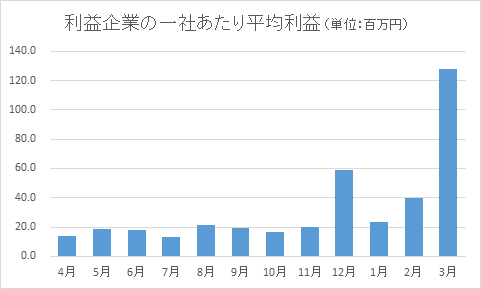
Among profitable companies (excluding companies that made a loss), those with a March fiscal year-end have by far the highest average profit per company!
The figure is an astonishing more than ¥120 million.
But wait a moment.
Toyota also has a March fiscal year-end.
We must not forget that roughly 70% of listed companies have a March fiscal year-end. Many large companies close their books in March.
Even so, does joining the ranks of profitable companies with a March fiscal year-end not sound rather appealing?
(For Those Who Play Defense) Which Fiscal Year-End Month Has the Smallest Losses?!
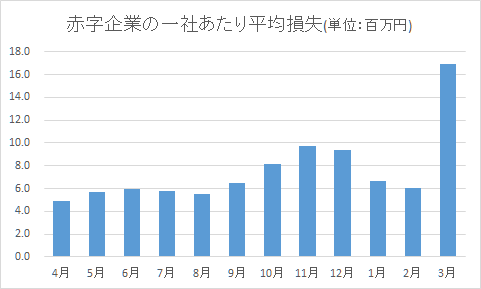
Isn't this a rather surprising result?
Companies with October and November fiscal year-ends have lower profits among profitable companies and larger losses among loss-making companies. That is rough.
If you are choosing based on good luck, these options are out.
Companies with an April fiscal year-end have the smallest losses. The average loss is just over ¥4 million.
If you are the conservative type who prefers to play defense, I recommend an April fiscal year-end.
(For the Balanced Type) Which Fiscal Year-End Month Is Best Overall?!
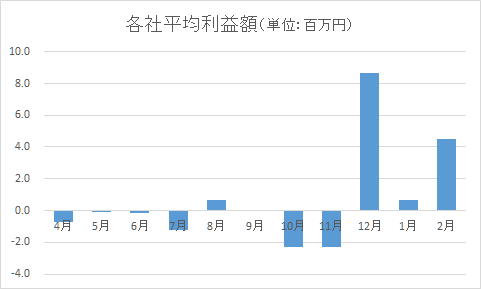
Would you look at that.
On average, only companies with August, December, January, and February fiscal year-ends are profitable. All the others post losses on average.
Looking at this, December is the overwhelming winner.
For tax accountants, work for December year-ends coincides with the busy tax-return season, so inevitably we have less capacity. As an industry, we would prefer you to avoid December... but still...
The 2015 article concluded as follows:
So, what did you think? If more people become particular about choosing their fiscal year-end month, writing this article will have been worthwhile.